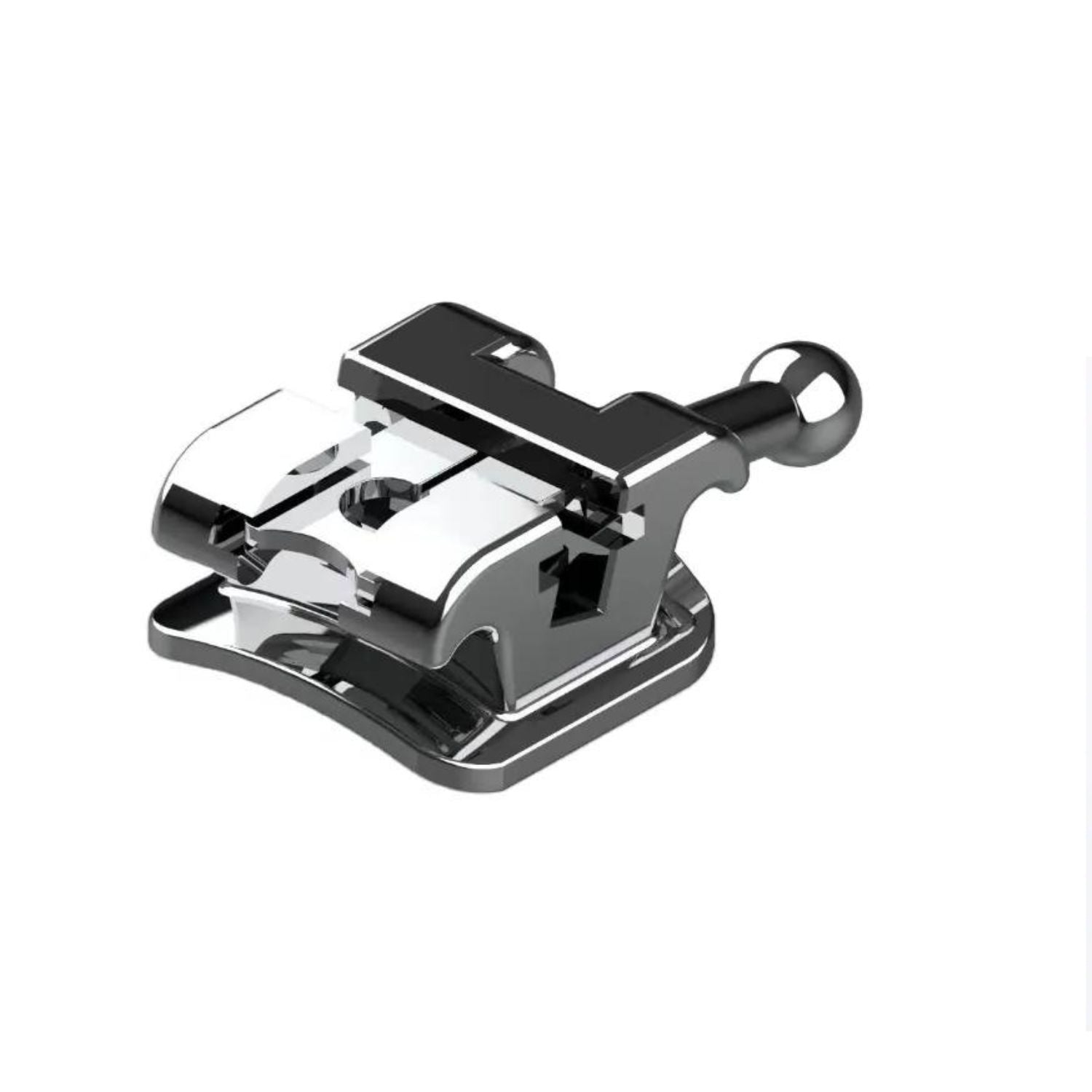
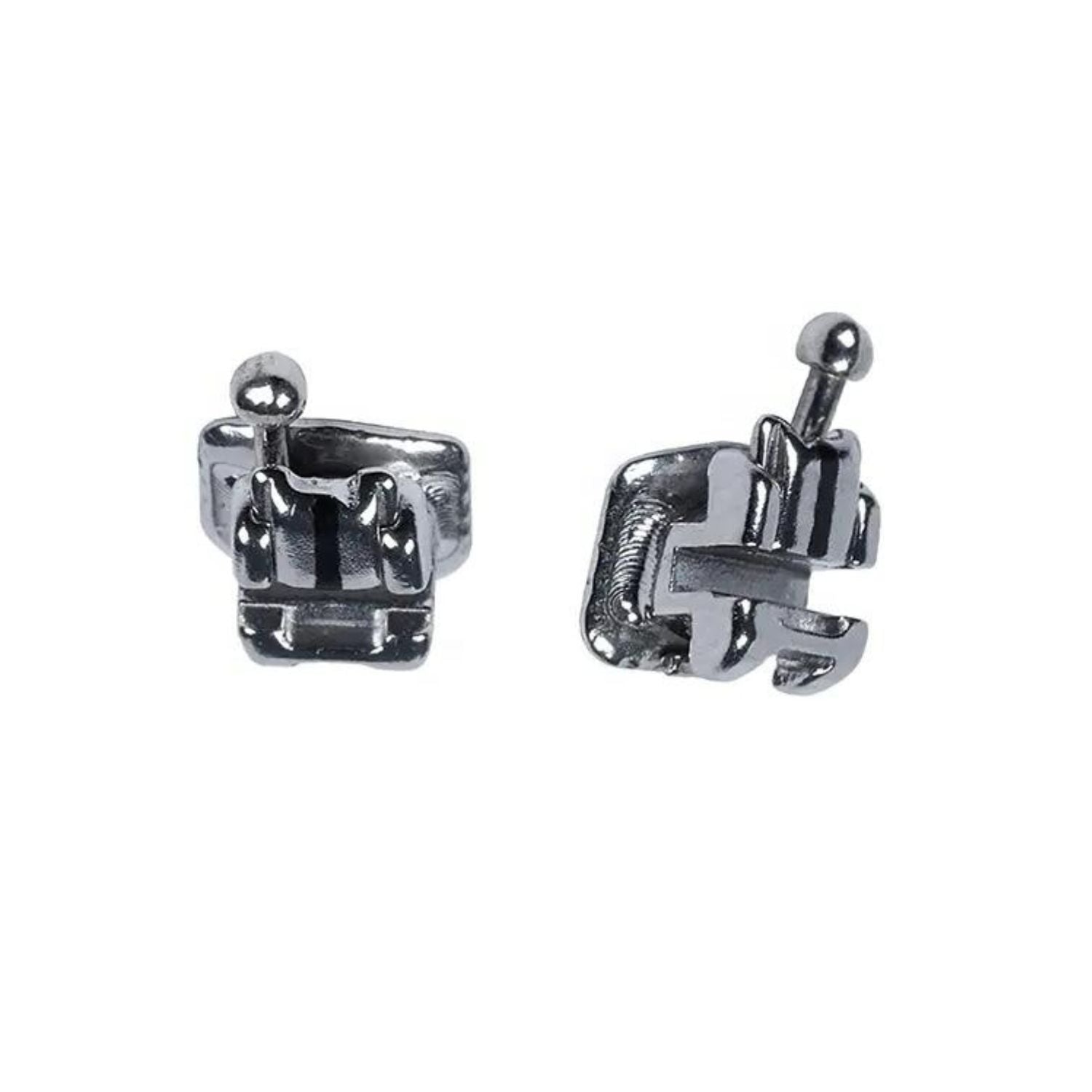
Above the Fold
Spec |
Value |
Slot / Rx |
0.022" (approx. 0.559 mm) · MBT |
Hooks |
All four canines · FDI 13/23/43/33 · Universal 6/11/22/27 |
Pack |
28 metal brackets per box · SKU AS-DB-6-HDZS-1 |
This box covers MBT 0.022 cases with hooks on all four canines, the standard canine-hook configuration, nothing exotic. Single-box or stock-up pricing is available at checkout: $2.57 per bracket at single-box price, down to $2.31 at ten boxes. Free US shipping, no order minimum.
Body Content
Specifications
Field |
Value |
Slot |
0.022" (approx. 0.559 mm) |
Prescription |
MBT |
Hooks |
All four canines · FDI 13/23/43/33 = Universal 6/11/22/27 — "hooks on 3's" |
Quantity |
28 metal brackets per box |
Body material |
Medical-grade stainless steel · MIM (metal injection molded) |
Clip material |
NiTi |
Base |
80-mesh mechanical-retention base |
Bonding surface |
Laser-welded assembly |
Axis mark |
Permanent vertical axis mark for long-axis alignment |
SKU |
AS-DB-6-HDZS-1 |
Brand |
ISDENT / Istar Dental Supply |
What 0.022 means for your wire selection
The 0.022" slot measures approximately 0.559 mm. That extra clearance over a 0.018" slot means your finishing wire is typically .019×.025 stainless steel. It fills most of the slot width while leaving enough room for torque expression. During initial leveling and aligning, when you are running .014 or .016 round NiTi, the play is larger. At that stage the friction differences between wire materials, NiTi versus stainless versus TMA, are smaller because the wire is not engaging the slot walls fully. The practical implication is that wire selection in the lighter stages is more flexible, and you commit to your finishing wire choice later in treatment.
For MBT prescription, the torque and tip values are built into the bracket slot. The per-tooth values for this generation are available from Istar Dental Supply on request. Verify the data sheet before you place a large order if your torque prescription is exacting.
Hooks on all four canines
The hooks sit on the four canines: upper right (FDI 13, Universal 6), upper left (FDI 23, Universal 11), lower right (FDI 43, Universal 27), and lower left (FDI 33, Universal 22). That is the industry-standard "hooks on 3's" configuration: every quadrant, canines only, no premolar hooks. If your protocol calls for hooks on 3-4-5, you need a different SKU. See the configuration guide below.
Keeping the door working: chair-side reality
Self-ligating clips fail at the chair in predictable ways. A 2009 Orthotown poll of 29 orthodontists found 28 percent cited calculus-impacted lower anteriors as their top frustration, and 10 percent reported clip fracture. Ziehmer, a practicing orthodontist, described it plainly in a 2015 column: "my staff and I frequently struggled with doors opening properly, especially in adult patients with calculus accumulation in the lower anterior region."
That failure mode is mechanical, not a defect. Calculus or food debris bridges the gap between the clip and the bracket body, blocking the clip's travel before it completes its arc. Four steps that work:
-
Clear the bracket before attempting to open it. A scaler pass along the gingival tie-wing removes the debris that is physically stopping the clip. Do not skip this step and apply more force instead.
-
Use the designated opening instrument, not a ligature director or explorer tip. The correct tool engages the clip at its designed leverage point. A substitute instrument bends the clip.
-
Do not force a stuck clip. The 10 percent fracture rate in that same poll is almost always preceded by forcing. A bent or fractured clip means bracket replacement, not just a chair-time hit.
-
Replace the bracket once the clip has been bent. A deformed clip no longer seats to the same force specification. Continuing to use it introduces unintended play into the slot.
One point worth stating directly: wire changes are quicker than with conventional brackets. The AAO Committee on Scientific Affairs puts the per-arch saving at approximately 20 seconds (AJODO 2010;138:128-31). What the evidence does not support is a shorter overall case. A 2014 meta-analysis of 25 trials and 1,321 patients found no statistically significant difference in total treatment duration, and a multi-center RCT reported 25.12 versus 25.80 months, P = .51. Specify self-ligating for the chair-time advantage. Plan your case length the same way you would with conventional brackets.
FAQ
What finishing wire goes with a 0.022 slot?
The standard finishing wire for a 0.022" slot is .019×.025 stainless steel, which fills approximately 86 percent of slot width. .017×.025 or .018×.025 stainless are also used depending on the clinical stage. NiTi, stainless, and TMA are all mechanically compatible with the slot dimension.
What is the return window?
Brackets must be unused, in original packaging, and a return request must be initiated within 15 days of receipt. For health and hygiene reasons, brackets removed from sterile packaging without a documented defect are not returnable. Return shipping is at the buyer's expense. Contact info@istardentalsupply.com before sending anything back.
How long does US shipping take?
Orders ship free to US addresses. Delivery typically takes 7-15 business days from order confirmation. Ordering 5- or 10-box quantities minimizes reorder frequency; see pricing tiers at checkout.
Shipping, returns, and payment
Free shipping to all US addresses, no order minimum and no surcharge on this SKU. US delivery: 7-15 business days. International orders: 15-20 days. Free shipping applies at all quantity tiers.
Returns: initiate within 15 days of receipt. The item must be unused and in original packaging. Non-defective items are subject to hygiene-based return restrictions under Istar's Return & Refund Policy. The buyer covers return postage. Full policy at /pages/return-refund-policy.
Payment: Visa, Mastercard, American Express, Discover, PayPal, and offline bank transfer. For large orders a 50 percent deposit is standard; contact the team to arrange terms. Details at /pages/payment-information.
Explore related products: orthodontic brackets.
For further reading: ISO overview of orthodontic brackets and tubes.