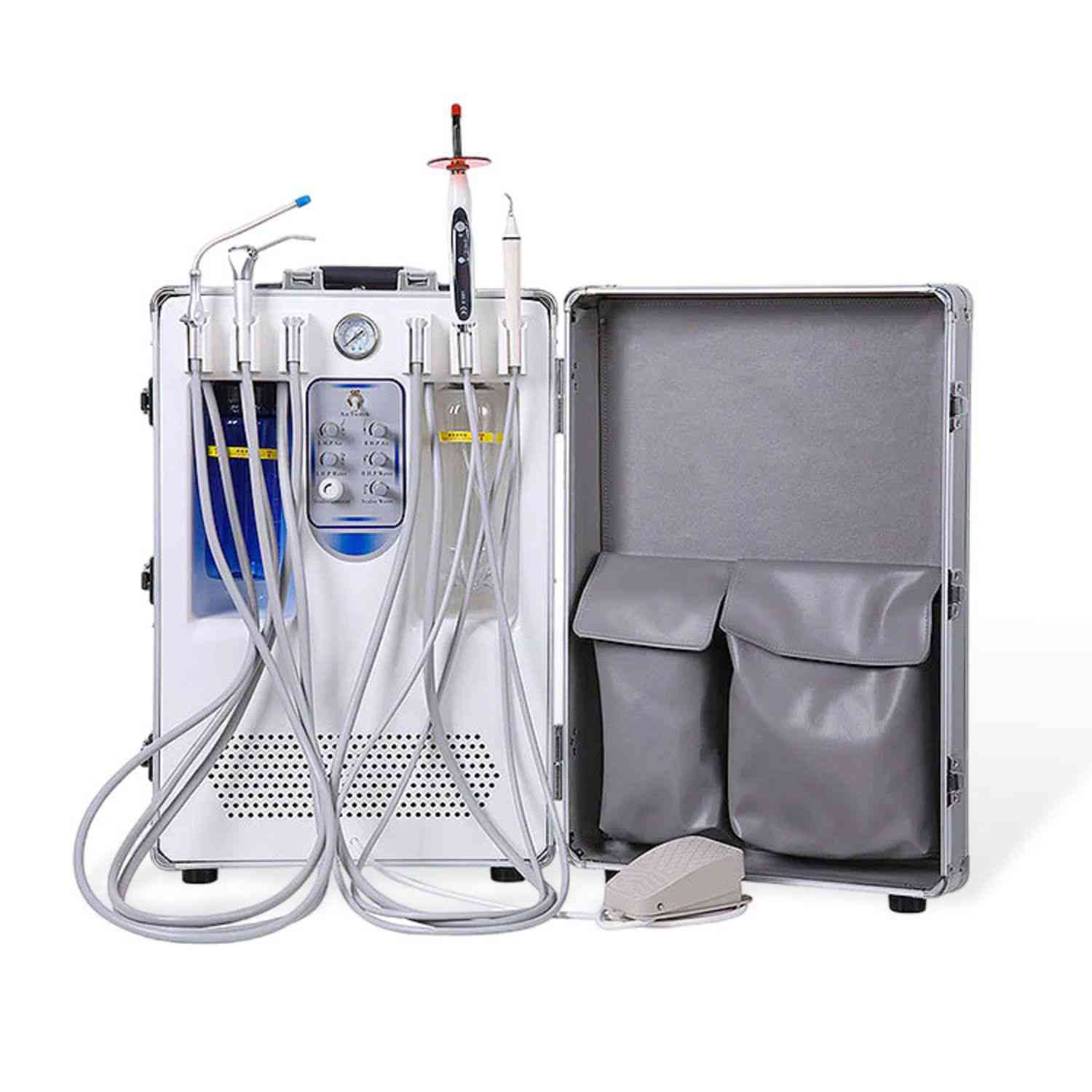
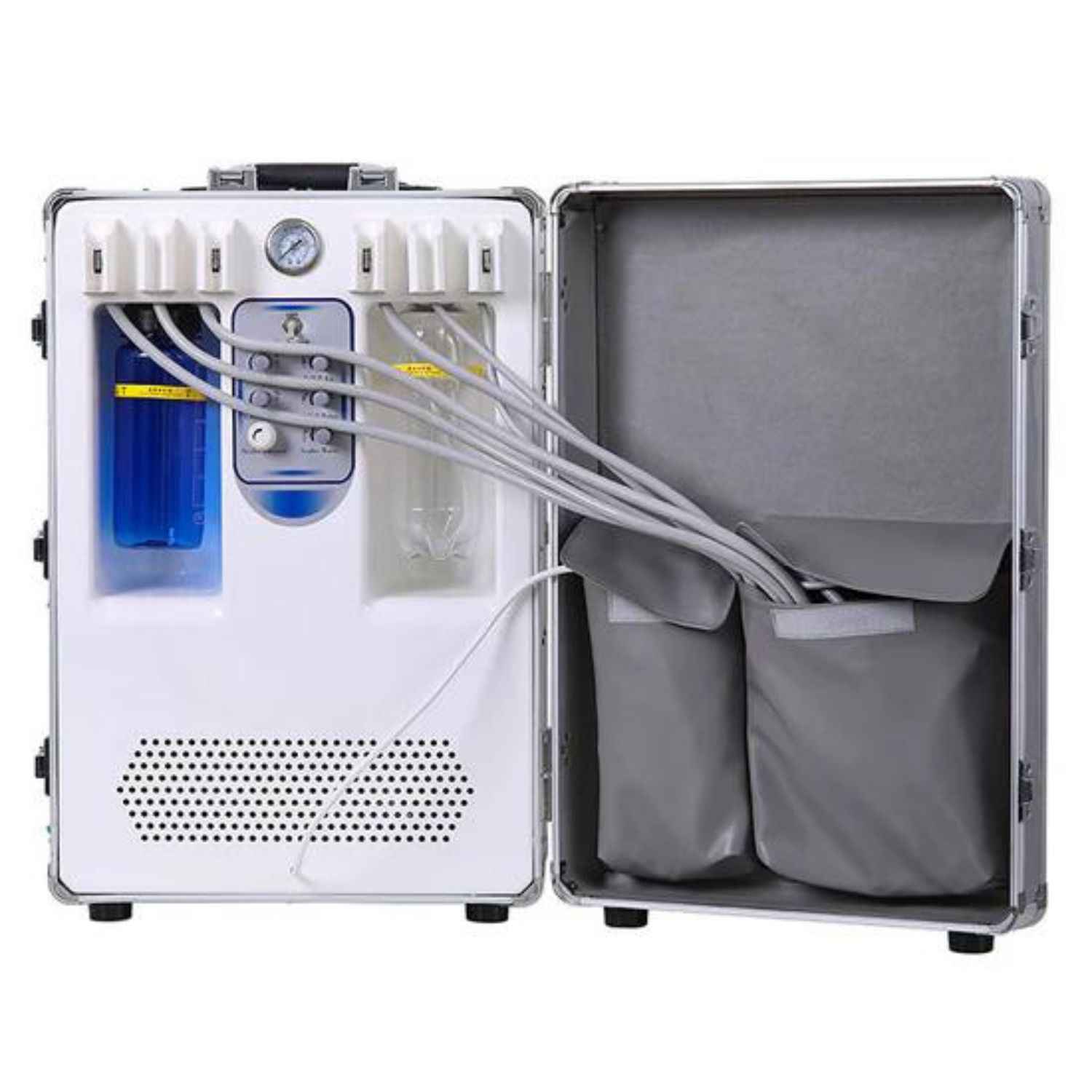
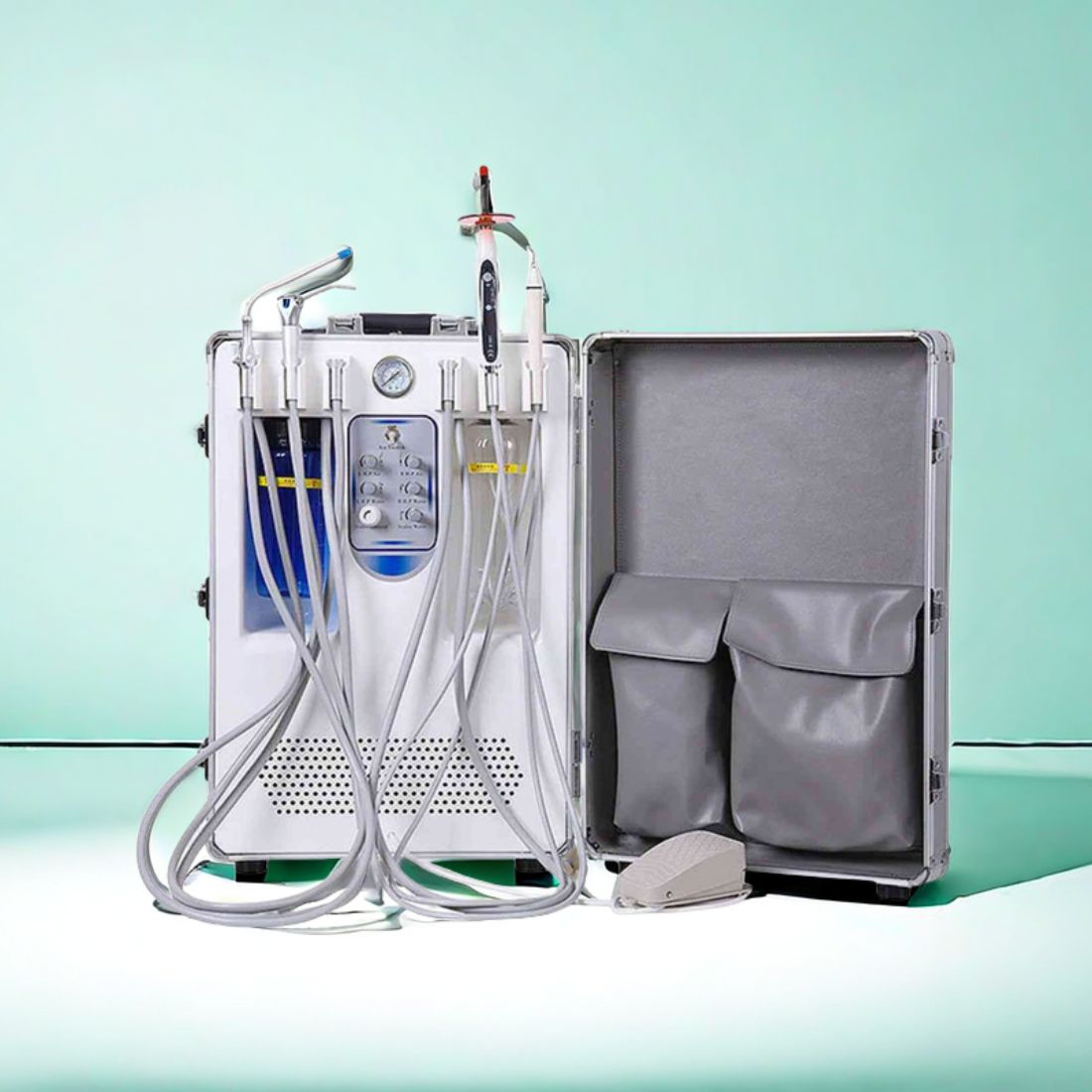
- A self-contained dental turbine unit: built-in oil-free compressor (600 W, 130 L/min) and 6 L air tank, plus a water bottle, suction, 3-way syringe and foot control, all in one aluminum rolling case.
- High-speed and low-speed handpieces included. Choose a 2-hole or 4-hole handpiece connection.
- The 6 Bracket version adds a built-in ultrasonic scaler and LED curing light.
- Net weight 34 kg (75 lb). Rated noise 40 dB.
- For US clinics, order 110V 60Hz with the USA plug. The 220V 50Hz version pairs with the Euro, UK or Australia plug.
This portable dental turbine unit brings its own air. An oil-free compressor fills a 6 L tank, a pressurized bottle sends water to the handpieces and 3-way syringe, and the suction line empties into a drain bottle. Plug it into a wall outlet, step on the foot control, and the high-speed handpiece runs. You don't need a compressor room or an air line through the wall.
Four choices set your exact unit: configuration, handpiece connection, voltage and plug.
What's in the case
Item |
Basic 4 Bracket |
6 Bracket |
Oil-free compressor motor |
1 |
1 |
6 L air tank |
1 |
1 |
High-speed handpiece, with hose |
1 |
1 |
Low-speed handpiece, with hose |
1 |
1 |
3-way syringe |
1 |
1 |
Adjustable high suction |
1 |
1 |
Water bottle |
1 |
1 |
Drain bottle |
1 |
1 |
Foot control |
1 |
1 |
Built-in ultrasonic scaler |
— |
1 |
Built-in LED curing light |
— |
1 |
The lid carries a bag for your instruments.
Basic 4 Bracket or 6 Bracket?
Both versions share the same compressor, tank and handpiece lines. The 6 Bracket adds a built-in ultrasonic scaler and an LED curing light, along with two extra dials on the panel: one for scaler power and one for scaler water.
So the question is what else you'll carry. If a scaling appointment and a small composite can land on the same visit, the 6 Bracket keeps both on one panel and one power cord. Already own a scaler and a curing light you're happy with? The Basic 4 Bracket costs less and leaves you with fewer parts to look after. Standalone ultrasonic scalers and dental curing lights are in our catalog if you'd rather keep them separate.
Handpiece connection: 2-hole or 4-hole
The hole count describes the coupler at the end of each handpiece hose. ISO 9168 defines four types of hose connector between air-driven handpieces and a dental unit's hoses, which carry drive air and water and, on some types, light and an exhaust path.
-
2-hole is the Borden-style coupler. It has no separate exhaust port and is more common outside the US.
-
4-hole is the Midwest-style coupler. It adds a dedicated exhaust port, the largest of the four holes. Most US offices run this type.
Not sure which you have? Turn over a handpiece you already use and count the holes in its back end. Pick the same number here and your existing handpieces will thread onto this dental turbine unit's hoses. Both options cost the same.
Voltage and plug
Each unit is built for one supply voltage, so choose by where you'll plug it in:
-
US and other 110V 60Hz regions: 110V 60Hz with the USA plug.
-
Europe, the UK, Australia and other 220V 50Hz regions: 220V 50Hz with the Euro, UK or Australia plug.
A plug adapter changes the shape of the plug, not the voltage. If you'll work in countries with different mains power, message us on WhatsApp before you order.
Portable dental turbine unit specifications
Spec |
Value |
Model |
BD-406-4 (Basic 4 Bracket), BD-406-6 (6 Bracket) |
Compressor |
Oil-free, 600 W |
Rated flow |
130 L/min (4.6 CFM) |
Air tank |
6 L (1.6 gal) |
High-speed handpiece |
0.18–0.22 MPa (26–32 psi) working pressure, ≥300,000 rpm |
Low-speed handpiece |
0.28–0.32 MPa (41–46 psi) working pressure, ≥14,000 rpm |
Rated noise |
40 dB |
Net weight |
34 kg (75 lb) |
Packing size |
56 × 42 × 76 cm (22 × 16.5 × 30 in) |
Case |
Thickened aluminum alloy, wheels, telescoping pull handle |
Power supply |
110V 60Hz or 220V 50Hz |
Plug |
USA, Euro, UK or Australia |
Fuse |
8A / 15A |
Handpiece connection |
2-hole or 4-hole |
Water |
Distilled water only |
Compressor power, flow, noise, weight and packing size are taken from the BD-406 spec sheet.
Reading the handpiece pressures
The two pressure ranges above are working pressures at the handpiece, not tank pressure. Each handpiece line has its own air and water adjustor on the front panel, so you set them separately.
For the high-speed handpiece, set the handpiece switch to high-speed and bring the air to 0.18–0.22 MPa (26–32 psi). That's where it should reach its standard speed of 300,000 rpm or more. The low-speed handpiece wants more air: 0.28–0.32 MPa (41–46 psi) for 14,000 rpm or more. If your handpiece's own manual gives a different figure, the manual wins.
Turning the air past the range doesn't buy you extra cutting power for free. Hughes Dental Repair, a handpiece repair service, puts high air pressure first on its list of reasons turbine bearings fail. The same page warns that running a handpiece with no bur in it can damage the chuck and spindle, so seat a bur or test bar before you start it.
Flow, tank and weight
130 L/min (4.6 CFM) is the compressor's rated output. The 6 L tank covers the quick pulses when you tap the foot control. Through a long preparation, it's the compressor's output that keeps the handpiece fed.
At 34 kg (75 lb), the case rolls on its wheels with the handle extended, across a clinic floor or a parking lot. Getting it into a car trunk or up a flight of stairs is a two-person lift. If that's more than you want to carry, compare our other portable dental units with a compressor, including a backpack model.
Setting up and caring for your dental turbine unit
First power-up. The oil-free compressor comes pre-tested. Switch on the power and it starts by itself, fills the tank, stops at its set pressure and restarts as the pressure drops. Leave the compressor and its pressure controller as they are. Adjusting or opening them can damage the unit and is a safety hazard.
Handpieces and syringe.
- Line the coupler up with the hose nut before you turn it. A cross-threaded coupler is hard to save.
- To fit the 3-way syringe tip, press the ring nut down, insert the tip, then release the ring nut to lock it. The water control on the syringe sets the flow.
- Lubricate each handpiece after every use and before sterilization. If the handpiece manual calls for steam sterilization, let it cool to room temperature on its own. Hughes notes that running cold water over a hot handpiece damages the ball bearings, and that soaking in cold chemical sterilant damages the handpiece.
Water bottle. This bottle feeds the high-speed handpiece, the low-speed handpiece and the 3-way syringe, and the air system pressurizes it to push that water out.
- Fill with distilled water only. Minerals in tap water can leave scale in the unit's small waterlines.
- Turn off the water bottle air switch before you unscrew the bottle.
- Fill it no more than three-quarters full.
- Screw it back on firmly. A loose bottle leaks air.
Saliva and drain bottles.
- Empty them when they reach 75% full. If a bottle goes past that, clean it before you keep working.
- At the end of the day, suction a cup of purified water through the saliva ejector to flush the tubing and bottle. Then remove the drain bottle, rinse it, disinfect it and refit it.
Condensed water. Compressed air carries moisture, and water from a compressor's air storage is on Hughes' list of bearing-failure causes too. The water drain valve (No. 20 on the 6 Bracket diagram, No. 16 on the Basic) lets that water out of the system.
Shipping, warranty and returns
Shipping. Shipping is free. The dental turbine unit goes by sea and takes about 30–40 days to reach the US and 40–50 days to reach other countries.
Warranty. The unit carries a 6-month warranty. To report a fault, email info@istardentalsupply.com or message us on WhatsApp with your order number and photos of the problem.
Cancellations. You can cancel within 12 hours of ordering, before the unit ships, and the refund comes back within 48 hours.
Returns. Returns follow our Return & Refund Policy: the unit has to be unused and in its original packaging, and every return starts with a request to us (we reply within 12 hours). Unless we've agreed otherwise, you pay return shipping, so use a tracked and insured service. Once the unit is inspected and approved, the refund goes to your original payment method, usually within 3–5 business days.
FAQ
What is a dental turbine?
A dental turbine is the rotor assembly inside the head of a high-speed handpiece. Compressed air spins its impeller, bearings support the spinning rotor, and the chuck holds the bur. This unit isn't a replacement turbine. It's the portable delivery system that supplies the air, water and suction a turbine handpiece needs.
Can I add more handpieces later?
Yes. An extra screw-on handpiece only needs the coupler type you chose above. A quick-connect handpiece also needs the quick coupling made for it, which goes between the hose and the handpiece. You'll find handpieces in our dental handpieces range.
Can I order several units at once?
Yes. For two or more units, or if you'd like to carry Istar equipment as a dealer, message us on WhatsApp or see our dental equipment distributor program. Larger orders can also be paid by bank transfer with a 50% deposit, with the balance due once shipping is confirmed.
Choose the configuration, handpiece connection, voltage and plug above, then add the portable dental turbine unit to your cart. Not sure which coupler your handpieces use? Send a photo of a handpiece's back end on WhatsApp and we'll tell you before you order.