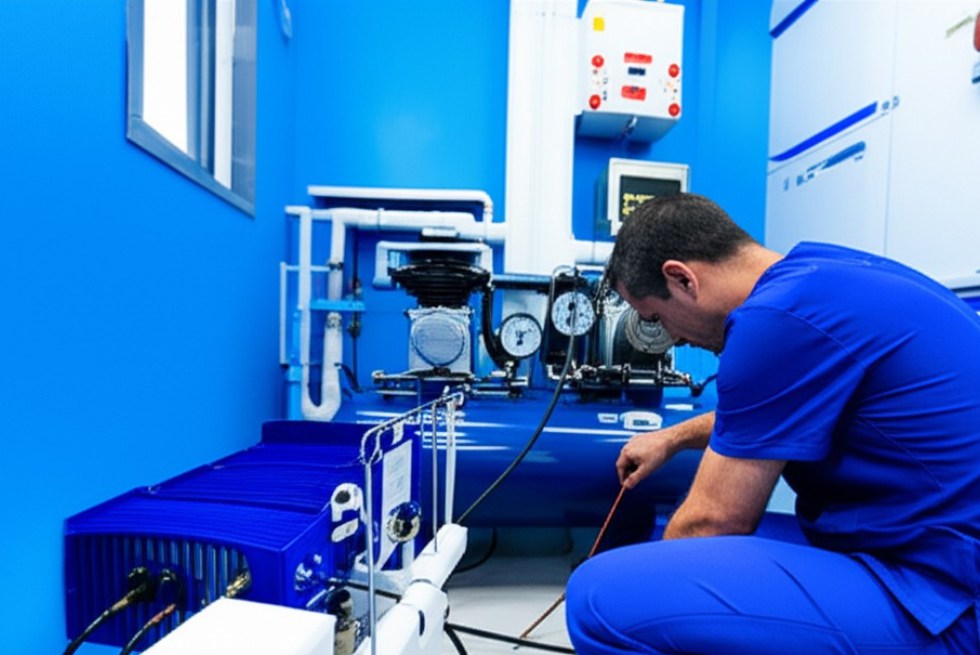
How to Connect a Dental Compressor: A Calm, Step-by-Step Guide for Real Clinics
If you’re staring at a brand-new compressor, some pipes, and a dental chair wondering “How on earth does this all hook together?” — you’re absolutely not alone.
Connecting a dental compressor isn’t just about screwing on a hose. You’re tying the “lungs” of your clinic into a system that has to deliver clean, dry, reliable air every day, under real-world stress, while staying inside local codes and health standards.
-
This guide is written for:
-
Dentists opening or relocating a clinic
-
Practice owners replacing an old compressor
-
Clinic managers who want to understand what their contractors are doing
-
Technicians in training who want a more “human” explanation alongside manufacturer manuals
⚠️ Important safety note: This article gives you a high-level, best-practice workflow. Always follow your compressor’s installation manual, local plumbing/electrical codes, and, when in doubt, use a licensed electrician and qualified dental equipment installer.
1. Before You Touch a Wrench: Big-Picture Planning
Before you think about fittings and thread tape, zoom out: a dental air system is a regulated, medical-adjacent system. In most clinics, dental air is treated as Category 3 medical gas — any interruption is uncomfortable and disruptive, but not directly life-threatening — and it still needs clean, dry air and properly sized piping.
Good manufacturers and codes all repeat the same themes:
-
Keep the compressor in a clean, dry, well-ventilated room with a controlled temperature range (often around 40–100 °F / 4–38 °C).
-
Protect the air intake from moisture, animals, and contaminants, often using a dedicated intake pipe.
-
Plan for drains (for condensate and dryer discharge) and easy access for service.
-
Pre-connection questions to answer:
-
Where will the compressor live, and how hot/cold/noisy is that room?
-
How many chairs / operatories will it feed now — and in 5–10 years?
-
Where is the main air manifold or riser that feeds the clinic?
-
Where can you safely send condensate (floor drain, condensate can, etc.)?
-
Do you have a dedicated electrical circuit sized per the compressor spec?
-
Who signs off on code compliance — your contractor, landlord, or facilities team?

2. Meet the Main Components You’ll Be Connecting
Take a moment to visualize the system. Most dental setups, whether single chair or multi-op, follow a similar flow:
Compressor → Filters/Dryer → Main Shutoff → Building Piping → Branch Lines → Chair/Unit → Handpieces & Syringes
To keep this concrete, here’s a quick reference table.
Core Dental Air Components and What You Connect
|
Component |
What it actually does |
What you connect it to |
Connection tips you’ll be glad you followed |
|
Compressor (pump + tank) |
Creates and stores compressed air |
Outlet piping, electrical supply, sometimes remote intake |
Use flexible hose between tank and hard piping to absorb vibration. |
|
Coalescing filter |
Pulls out oil mist and fine droplets |
Compressor outlet → dryer or manifold |
Install with easy access for element changes. |
|
Dryer (membrane or desiccant) |
Lowers dew point so air is dry and safe for dental tools |
After filter; before distribution piping |
Make sure drain tubing can slope to a safe drain point. |
|
Main shutoff valve |
Lets you isolate the entire clinic air system |
Downstream of compressor, before the main distribution header |
Use a full-port ball valve and label it clearly. |
|
Main air line / header |
Carries air around the clinic |
From compressor room to manifolds or junction boxes |
Commonly copper or approved plastic per code; size for future chairs. |
|
Branch lines to chairs |
Drop from the main line to each operatory |
From header to chair junction box or floor box |
Include local shutoff valves per room where possible. |
|
Chair / delivery unit |
Mixes air, water, and vacuum for actual treatment tools |
Air, water, power, and vacuum connections |
Follow the chair manufacturer’s rough-in and connection guides strictly. |
|
Pressure regulators & gauges |
Let you tune and verify pressure at the system or chair level |
Often at compressor outlet and/or in each chair or cabinet |
Set within manufacturer ranges for your handpieces and syringes. |
-
Typical physical connection points (you’ll see these labels a lot):
-
Compressor outlet: often a shutoff valve with a threaded female outlet (e.g., 3/8" or 1/2" NPT).
-
Flexible hose: connects compressor outlet to rigid building piping (copper, etc.).
-
Main header: usually 1/2" or larger copper pipe running through/above the clinic.
-
Drops to chairs: smaller branches feeding wall or floor junction boxes beneath or near each chair.
-
Chair umbilical: bundled hose set with quick-connect or compression fittings to the junction box.
3. Step 1 – Choose and Prepare the Compressor Room
Picking the right room is one of the biggest “future you will be grateful” decisions.
Manufacturers and independent guides consistently recommend a central, clean, dry space where the compressor can pull in good air and be serviced easily — not a forgotten corner of a boiler room or a damp basement. Hot, humid, or smelly environments feed moisture and contaminants straight into your air system.
You also need to think about:
-
Ventilation: compressors are air-cooled; if heat builds up, they work harder and die younger.
-
Noise: modern dental compressors are quieter, but you probably still don’t want them humming next to a consult room.
-
Floor and wall structure: solid, level surface; potential for anchoring where required.
-
Room prep checklist:
-
Clear enough space for the compressor plus 6–20" (15–50 cm) of clearance around it per manual.
-
Confirm the ambient temperature stays within the manufacturer’s specified range (often 40–100 °F / 4–38 °C).
-
Identify or install a floor drain or condensate can location for drains.
-
Check that the main air header can be reached without crazy pipe runs or tight bends.
-
Make sure there’s enough headroom and lighting for maintenance and future upgrades.
4. Step 2 – Position and Secure the Compressor
Now you can bring the compressor into the prepared room.
Most installation manuals start with the same steps: remove shipping materials, install vibration-isolating feet, position the unit, and level it so oil and condensate behave properly inside.
Depending on your region, you may also need seismic restraints or anchoring, especially in areas with seismic building codes.
-
Positioning basics:
-
Install the rubber feet or isolators from the kit to reduce vibration and noise.
-
Place the compressor on a solid, level surface; use a bubble level if it’s built into the frame.
-
Maintain recommended clearance at sides and rear to allow airflow and service access.
-
If required by code, anchor the base to the floor using approved anchors and brackets.
-
Keep the control panel and gauges facing an accessible side — don’t back them into a corner.
5. Step 3 – Electrical and Controls (High-Level Only)
Here’s where we repeat the golden rule: let a licensed electrician handle the actual wiring.
Your job is to understand what they’re doing so you can plan the space and ask the right questions. Many dental compressors:
-
Need a dedicated circuit sized for their voltage and full-load amperage.
-
May be plug-in units on a specific NEMA receptacle or hard-wired with a disconnect box.
-
Often support remote on/off switches and indicator lights mounted outside the equipment room.
-
What to confirm with your electrician:
-
Voltage and phase (e.g., 120 V vs 208–230 V, single-phase vs three-phase) matches the compressor nameplate.
-
Breaker size and wire gauge are correct per manufacturer recommendations.
-
A lockable disconnect is installed where required so technicians can safely service the unit.
-
Remote start/stop and any status lights are wired per the compressor manual.
6. Step 4 – Fresh Air Intake and Room Ventilation
Quality in equals quality out. The air your compressor breathes is the air you put into patients’ mouths and instruments.
Many dental compressors either include or support a remote air intake manifold with a dedicated pipe (commonly around 2") that brings cleaner, cooler air from another location and protects it with a shroud and screen.
Good guides also warn against hiding compressors in damp basements or smelly mechanical rooms — warm, humid, odorous air raises the risk of contaminated lines.
-
Intake and ventilation do’s and don’ts:
-
✅ Do route intake from a cool, dry, clean location where possible.
-
✅ Do protect intake ends from rain, pests, and debris using a screened hood.
-
✅ Do add a drip leg with drain at low points on long intake runs to catch condensation.
-
❌ Don’t pull air from dental lab exhaust areas, sterilization vents, or near sewage lines.
-
❌ Don’t enclose the compressor in a tight cupboard without ventilation — heat kills compressors.

7. Step 5 – Condensate and Dryer Drain Connections
Compressed air always creates some moisture. In medical and dental environments, that moisture is more than just annoying — it’s a breeding ground for microbes, corrosion, and handpiece issues.
Your system may use:
-
A tank drain (manual or automatic)
-
A dryer drain (membrane or desiccant purge discharge)
-
A remote drip leg with drain valve
Manufacturers typically recommend routing these into a floor drain, floor sink, or dedicated condensate container, never where it can back up into the air system or drip onto the floor.
-
Drain connection tips:
-
Use rigid or semi-rigid tubing near the compressor where heat and vibration are highest, then transition to flexible tubing as needed.
-
Maintain a continuous downward slope to the drain point to prevent standing water.
-
Avoid tying into sanitary drains in ways that violate backflow or plumbing codes.
-
Label drain lines so future techs recognize what they are and don’t cut them “by accident.”
8. Step 6 – Connecting the Main Air Line
This is the heart of “connecting the compressor.”
Most dental systems connect the compressor tank/shutoff to a flexible hose, then into rigid building piping — often 1/2" copper for the main header, with appropriate fittings and joints approved for medical/dental systems.
The key design ideas:
-
Let the compressor move and vibrate a little without stressing rigid pipes.
-
Include a clearly accessible main shutoff valve near the compressor.
-
Size piping to minimize pressure drop to the farthest operatory.
-
Typical main-line connection sequence:
-
Install the manufacturer-supplied flex hose to the compressor outlet shutoff valve using thread sealant approved for compressed air.
-
Mount a full-port ball valve and, if desired, a union or quick-disconnect at the wall penetration.
-
Transition from the flex hose to your main copper or approved plastic header using proper fittings (no hardware-store hacks).
-
Add drip legs with small drains at low points in the header to catch moisture.
-
Pressure-test this section (usually with air and soapy water) before connecting to the rest of the clinic distribution.
9. Step 7 – Distribution to Dental Chairs / Operatories
From the main header, branch lines drop into each operatory. In many layouts, a junction box under or behind each chair carries:
-
Compressed air
-
Vacuum lines
-
Water
-
Sometimes additional utilities (e.g., nitrous, if used)
Dental plumbing specs often call for a dedicated air line to a junction box roughly under the chair base, coordinated with the chair manufacturer’s drawings.
-
What to check at each operatory:
-
The air branch to the room has its own shutoff valve, accessible above ceiling or in a cabinet.
-
The line terminates exactly where the chair manufacturer expects it (wall vs floor box, correct height/depth).
-
The connection between junction box and chair umbilical uses compatible fittings and is not under strain when the chair moves.
-
Any in-room pressure regulator and gauge are installed and readable without crawling on the floor.
10. Step 8 – Filters, Regulators, and Final Quality Checks
Once the mechanical connections are made, the job isn’t done until you’ve proved that the air you’re delivering is:
-
Dry enough (dew point below freezing at system pressure in many medical-grade systems).
-
Clean enough (particulate and oil filtration).
-
Stable enough (pressure doesn’t sag badly when multiple chairs run).
Most dental compressors include or support coalescing filters and dryers. Many clinics also install a master regulator and gauge in the compressor room and, optionally, local regulators at sensitive equipment.
-
Final commissioning checklist:
-
Slowly pressurize the system and do a leak check at all threaded and quick-connect joints using soapy water.
-
Verify system pressure at the compressor outlet, end of the header, and at the farthest chair under load.
-
Confirm dryer operation (check purge/discharge, dew point indicators if present).
-
Check air at the syringe/handpiece ports for no visible moisture and no unusual odor.
-
Record baseline values (pressure, cycle time, current draw) for future troubleshooting.
11. Common Mistakes (and How to Avoid Them)
A lot of compressor problems trace back to installation decisions made on a rushed day years ago.
-
Frequent pitfalls:
-
Hiding the compressor in a hot, damp, or smelly room, leading to dirty, wet air and shortened compressor life.
-
Running long, undersized air lines that drop pressure every time two hygienists work at once.
-
Skipping drip legs and drains, so water pools in low points and eventually spits out at the chair.
-
Using unapproved pipe materials or fittings not rated for medical/dental use.
-
No way to isolate individual rooms, forcing you to shut down the whole clinic for a single leak.
12. When You Should Absolutely Call a Pro
You can understand your system deeply and still choose to delegate parts of the job — that’s smart risk management, not weakness.
-
Get a qualified dental equipment installer or contractor involved if:
-
You’re building a multi-chair clinic or hospital clinic with central systems.
-
Your jurisdiction has strict medical gas or compressor permit requirements.
-
The existing building piping is old, undocumented, or obviously not intended for dental air.
-
You don’t have easy access to licensed trades for electrical and plumbing work.
13. A Simple Mental Map: How Everything Connects
Let’s mentally zoom through a small multi-chair clinic from left to right so the whole connection path feels intuitive.
-
Connection “story” from compressor to handpiece:
-
Compressor in a clean, ventilated room generates air and stores it in its tank.
-
Air passes through a shutoff valve, flex hose, coalescing filter, then a dryer that removes moisture.
-
From there, it enters the main header that runs above ceilings or in walls around the clinic.
-
Each operatory gets a branch line that drops into a junction box.
-
The chair umbilical connects that box to the chair/delivery unit, sometimes through a local regulator and shutoff.
-
At the end of the chain, your handpiece and air/water syringe see stable, clean, dry air — if everything upstream is done right.
14. After the Connection: Simple Maintenance That Protects Your Investment
Connecting the compressor is step one; keeping it happy is the long game.
Short, regular tasks will give you far more value than heroic repairs later. Many issues (water in lines, slow pressure, noisy cycles) can be completely avoided with small habits.
-
Post-installation habits to build:
-
Drain the tank and drip legs at recommended intervals (or verify automatic drains are actually working).
-
Replace filter elements on schedule, not only when they “look dirty.”
-
Log compressor cycle patterns; sudden changes often indicate leaks or drying issues.
-
Train at least two team members to recognize normal vs abnormal sounds, odors, and pressures.
15. Wrapping Up
Connecting a dental compressor is less about memorizing every fitting size and more about understanding a few big principles:
-
Protect the quality of air (location, intake, drying, filtration).
-
Protect the reliability of supply (right piping, isolation valves, good electrics).
-
Protect the people working on it (clear shutoffs, code-compliant installation).
If you use this guide alongside your manufacturer’s manual and local codes, you’ll be able to speak the same language as your contractors, spot bad shortcuts, and keep your clinic’s “lungs” healthy for years.