Why Dental Handpiece Ergonomics Matter
If you’ve ever finished a long operative block with a “buzzing” forearm, stiff fingers, or a neck that feels like it’s carrying a bowling ball, you already understand the headline: your handpiece isn’t just a tool — it’s a load-bearing interface between your body and the work. When that interface is poorly matched to how humans move, tiny inefficiencies stack up into fatigue, pain, and (too often) injury.
-
Early signals your handpiece (or setup) is costing you
-
White-knuckle grip by the end of the appointment
-
Wrist drifting into extension or deviation to “find the angle”
-
Fingers going numb/tingly after hygiene or crown prep
-
Shoulder creeping up toward your ear without noticing
-
You feel precise for the first patient… and “sloppy-tired” by the last
Understanding Ergonomics in Dentistry
Ergonomics in dentistry is the science of fitting instruments, workflow, and posture to the clinician — not forcing the clinician to adapt their body to the operatory. It’s especially important in dentistry because the job combines precision, static postures, and repetitive micro-movements for hours a day.
This isn’t hypothetical. Research consistently shows a high burden of work-related musculoskeletal symptoms among dental professionals, commonly in the neck, shoulders, back, and upper extremities.
-
Why dentistry is ergonomically “high-risk” by design
-
Fine motor control under magnification and time pressure
-
Prolonged static posture (muscle fatigue without “movement relief”)
-
Repetition + force (gripping, pinch load, scaling pressure)
-
Awkward joint angles (wrist deviation, shoulder abduction, forward head posture)
A deeper way to think about it: ergonomics is a system, not a product
A handpiece can be beautifully engineered and still feel “wrong” if the hose drag is high, the patient is too low, your lighting is off, or your assistant’s positioning makes you reach. So while this article centers on handpieces, the real win comes from treating ergonomics like a chain: tool → grip → wrist → elbow → shoulder → neck/back → endurance.
-
Quick self-check (30 seconds): what’s driving strain today?
-
Tool: weight, balance, vibration, head size
-
Setup: patient height, operator stool, loupes angle, light position
-
Workflow: how often you reposition, how far you reach, how long you hold static

The Impact of Ergonomic Dental Handpieces
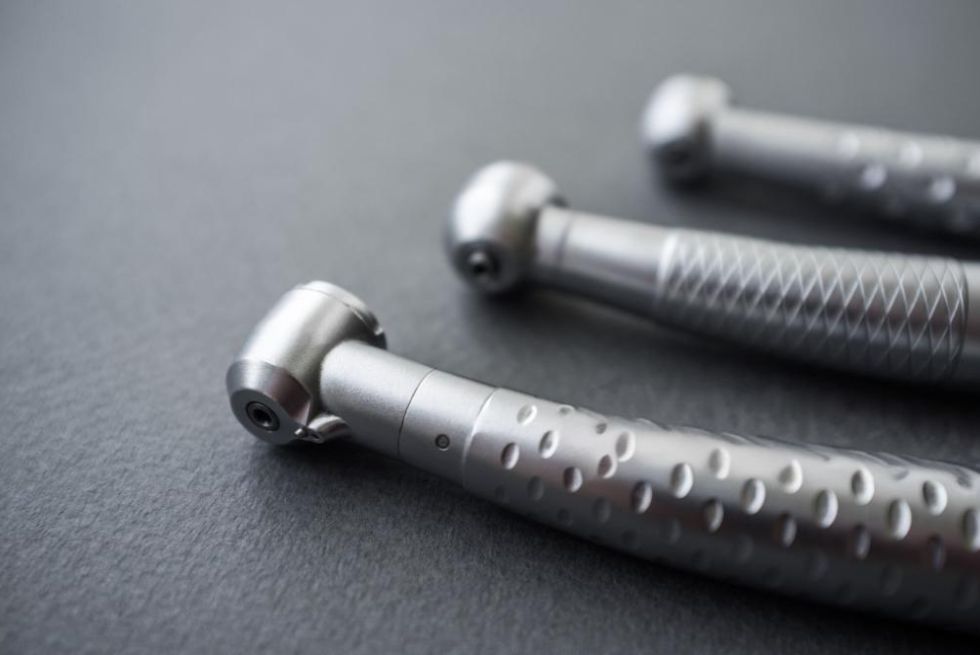
Most handpiece discussions stop at “lighter is better.” That’s a start, but the more useful question is: what does the design do to your grip force, joint angles, and sensory control over time? A handpiece that reduces required effort keeps you in the zone longer — the clinical zone where precision feels easy, not forced.
A well-designed handpiece can reduce the need for sustained pinch force and help keep the wrist closer to neutral, which matters because prolonged static contraction and awkward positioning are linked to fatigue and musculoskeletal strain in dental operators.
-
Ergonomic benefits that show up chairside
-
Less “death grip” because the instrument feels stable in hand
-
Better access without contorting your wrist (head size + visibility)
-
Reduced micro-corrections because balance and concentricity feel predictable
-
Smoother day-long endurance (you’re not burning stabilizer muscles constantly)
The invisible load: vibration and noise
Dental handpieces can transmit high-frequency vibration to the hand-arm system, and vibration exposure is a recognized occupational risk factor for upper-limb symptoms. Standards such as ISO 5349 describe how hand-transmitted vibration exposure is measured and reported, reinforcing that vibration isn’t just “annoying” — it’s measurable biomechanical stress.
Noise matters too. Even when it doesn’t damage hearing at dental-relevant levels, noise contributes to perceived effort, stress, and end-of-day depletion — the kind that subtly shortens patience and focus.
-
Ways vibration/noise show up clinically
-
Hand fatigue that feels disproportionate to the procedure
-
Tingling, reduced tactile sensitivity, or “clumsy fingers” later in the day
-
Increased mental load (you’re concentrating harder to stay controlled)
-
Patient tension (high-pitched sound can increase perceived discomfort)
Ergonomics is patient safety, too
When you’re fatigued, your fine motor control degrades first — and dentistry lives in the fine motor range. Better ergonomics supports steadier hands, more consistent margins, smoother finishing, and fewer “tiny slips” that you catch in time… until you don’t.
-
Patient-facing outcomes ergonomics can influence
-
More consistent precision during long appointments
-
Fewer pauses to reset grip/posture (smoother visit flow)
-
Reduced clinician stress, which patients often pick up immediately
Choosing Ergonomic Dental Equipment
Choosing an ergonomic handpiece isn’t about finding “the best brand.” It’s about finding the best match for your hand size, grip style, procedure mix, and operatory configuration. Two clinicians can pick up the same handpiece and have opposite experiences — because their biomechanics are different.
Also, “ergonomic” isn’t a single feature. It’s a bundle: weight + balance + diameter + texture + head size + hose swivel + vibration profile + thermal behavior + control layout. (Yes, that’s a lot — but you don’t have to guess. You can test.)
-
A simple, repeatable evaluation method (the 3×3 Fit Test)
-
3 grips: relaxed pen grasp, tighter “detail” grasp, indirect vision grasp
-
3 procedures: prep, finishing, occlusal adjustment (or your most common trio)
-
3 positions: maxillary posterior, mandibular posterior, anterior esthetic zone
-
Score each combo for: wrist neutrality, needed grip force, visibility, fatigue after 5 minutes
Ergonomic features that matter (and how to check them)
|
Ergonomic feature |
Why it matters |
Quick chairside test |
Red flag to notice |
|
Weight + balance (center of gravity) |
A front-heavy feel increases stabilizer fatigue |
Hold it at working angle for 60 seconds without “micro-squeezing” |
You unconsciously choke up or clamp down |
|
Handle diameter + texture |
Too small increases pinch force; too slippery increases grip |
Can you hold securely with relaxed fingers? |
Finger pads blanch / hand cramps |
|
Head size + visibility |
Smaller heads reduce awkward wrist angles in posterior access |
Simulate indirect vision on #2/#15 |
Wrist deviates to “see” the margin |
|
Hose drag + swivel |
Drag forces your hand to fight the line all day |
Let the hose hang and rotate through a prep arc |
Handpiece “pulls” out of alignment |
|
Vibration + noise |
Higher vibration increases fatigue and exposure load |
Compare two units on the same procedure |
Tingling or buzzing after a block |
|
Control layout (water/air, light) |
Awkward control increases micro-reaches and interruptions |
Can you adjust without breaking posture? |
Frequent stop-start or reaching |

Best Practices for Ergonomic Dental Work
The best handpiece in the world can’t compensate for a setup that forces you into poor posture. Ergonomics works best when you build a routine that protects neutral joint positions, reduces static load, and gives your tissues micro-recovery throughout the day.
Organizations and clinical ergonomics resources emphasize posture, positioning, and stretching/microbreak habits as practical strategies to reduce risk and restore movement quality over time.
-
Posture + positioning anchors (the “neutral first” rule)
-
Patient high enough that you’re not rounding your back to see
-
Elbows close to your sides (avoid sustained abduction)
-
Wrists as neutral as possible (less deviation/extension)
-
Light positioned so your neck doesn’t become the autofocus
-
Instruments within easy reach (reduce repeated micro-reaches)
Microbreaks that actually fit real dentistry
Microbreaks don’t have to be dramatic. Think: 20 seconds to reset the body that’s about to do precision work for the next 20 minutes. Even brief, consistent stretching breaks are commonly recommended in dental ergonomics education materials.
-
A practical “between-patients” microbreak menu (pick 2–3)
-
Shoulder rolls + scapular retraction (10 seconds)
-
Neck side-bend stretch (gentle, 5–10 seconds each side)
-
Wrist flexor/extensor stretch (5–10 seconds each)
-
Thoracic extension (hands behind head, open chest)
-
Hand “shake-out” + finger extension (restore circulation)
Make it measurable: the 2-minute weekly ergonomics audit
Human nature is funny: we’ll ignore low-grade discomfort until it becomes a loud problem. A quick self-audit makes ergonomics visible before pain becomes normal.
-
Weekly audit prompts
-
Where did you feel fatigue first this week (hand, shoulder, neck, back)?
-
Which procedure triggered the most tension?
-
Did you notice yourself gripping harder late-day?
-
Was hose drag, visibility, or positioning the real culprit?
-
What’s one small change you can test next week (height, swivel, light, microbreaks)?
Conclusion
Dental handpiece ergonomics matter because they sit at the exact point where clinical precision meets human biomechanics. The right handpiece can reduce unnecessary effort, support neutral positioning, and help protect you from the slow accumulation of fatigue that drives many work-related musculoskeletal problems in dentistry.
If you want a simple takeaway: choose tools that let you work with a relaxed grip and a neutral wrist — then build an operatory system that keeps you there.
-
Your quick “do I have an ergonomics win?” checklist
-
I can maintain control without squeezing
-
My wrist stays close to neutral in posterior access
-
Hose drag doesn’t steer my hand
-
Vibration/noise feels low enough that I’m not “buzzing” later
-
I take microbreaks often enough that fatigue doesn’t snowball